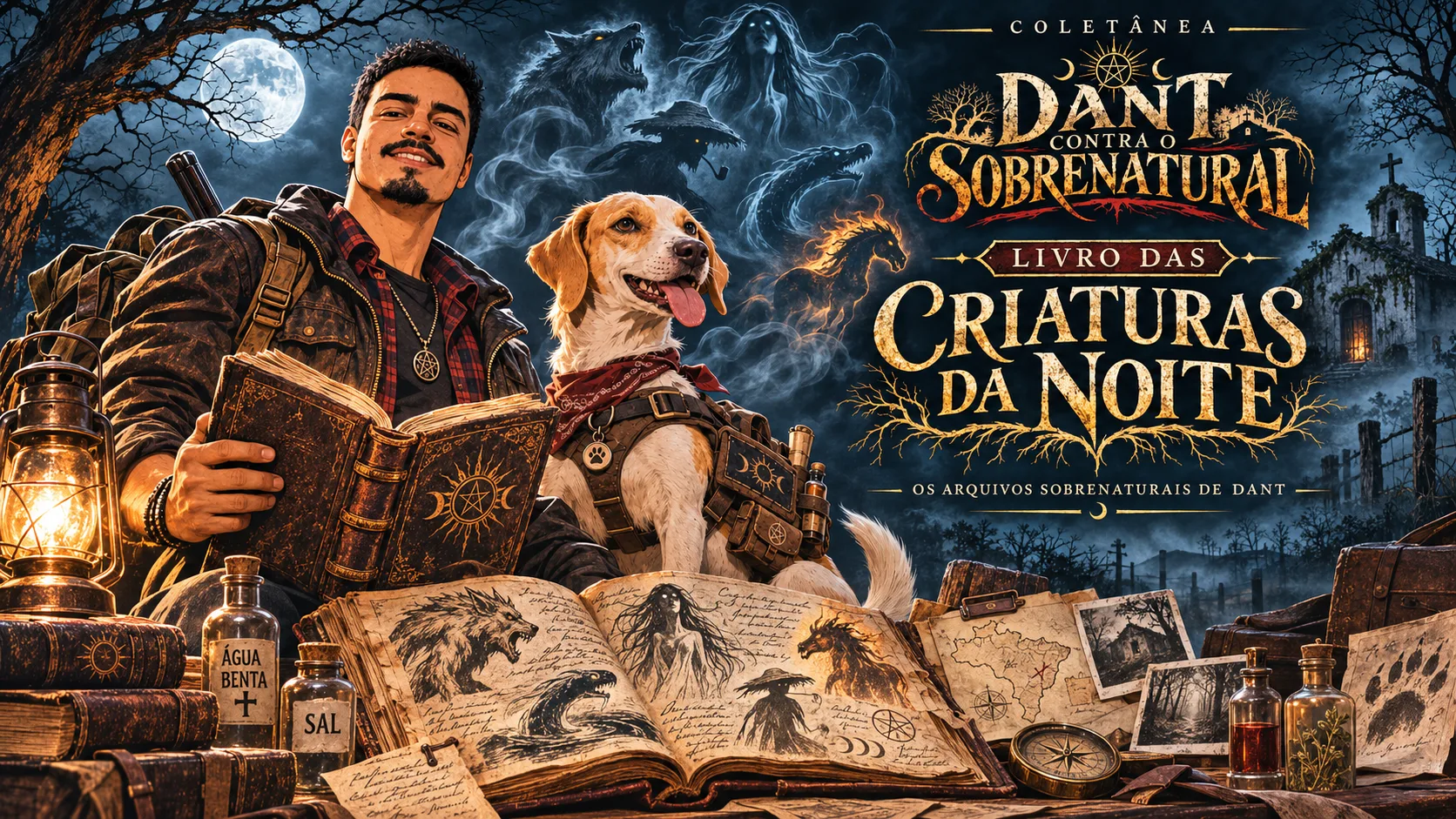
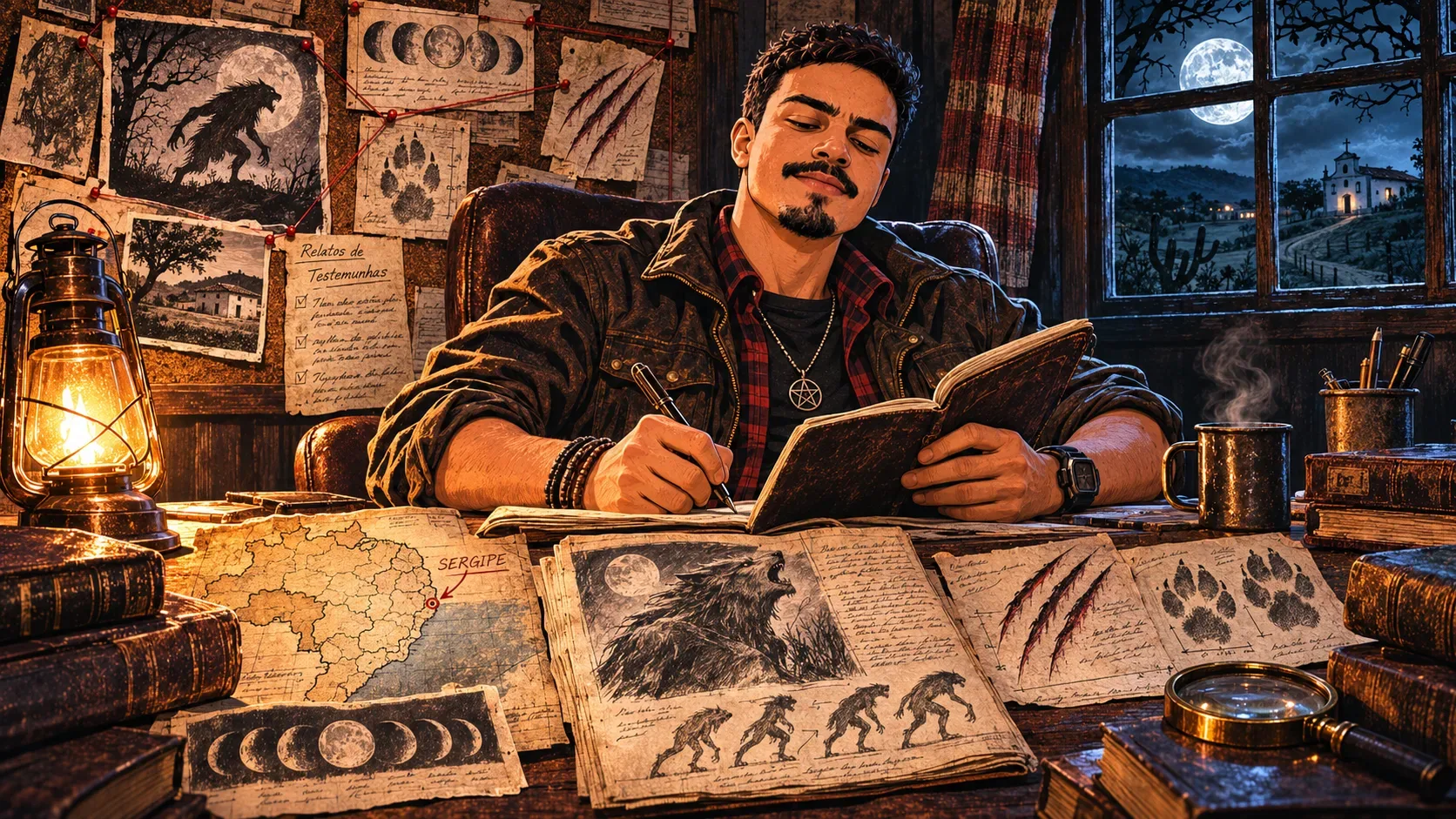
"The first creature I studied was the one that left me alive for a reason I still don't know. I won't make the mistake of assuming I know all the others."
FILE 001 | WEREWOLF
Dant's field notebook. Status: open investigation. Classification: variable threat, possibly a person undergoing transformation. I use three markers: [RECORD] for documents and traditions I have consulted, [FIELD] for what I witnessed, and [HYPOTHESIS] for what still needs testing. A legend may tell me where to look; it cannot prove that a method works.
1. The night in Simão Dias
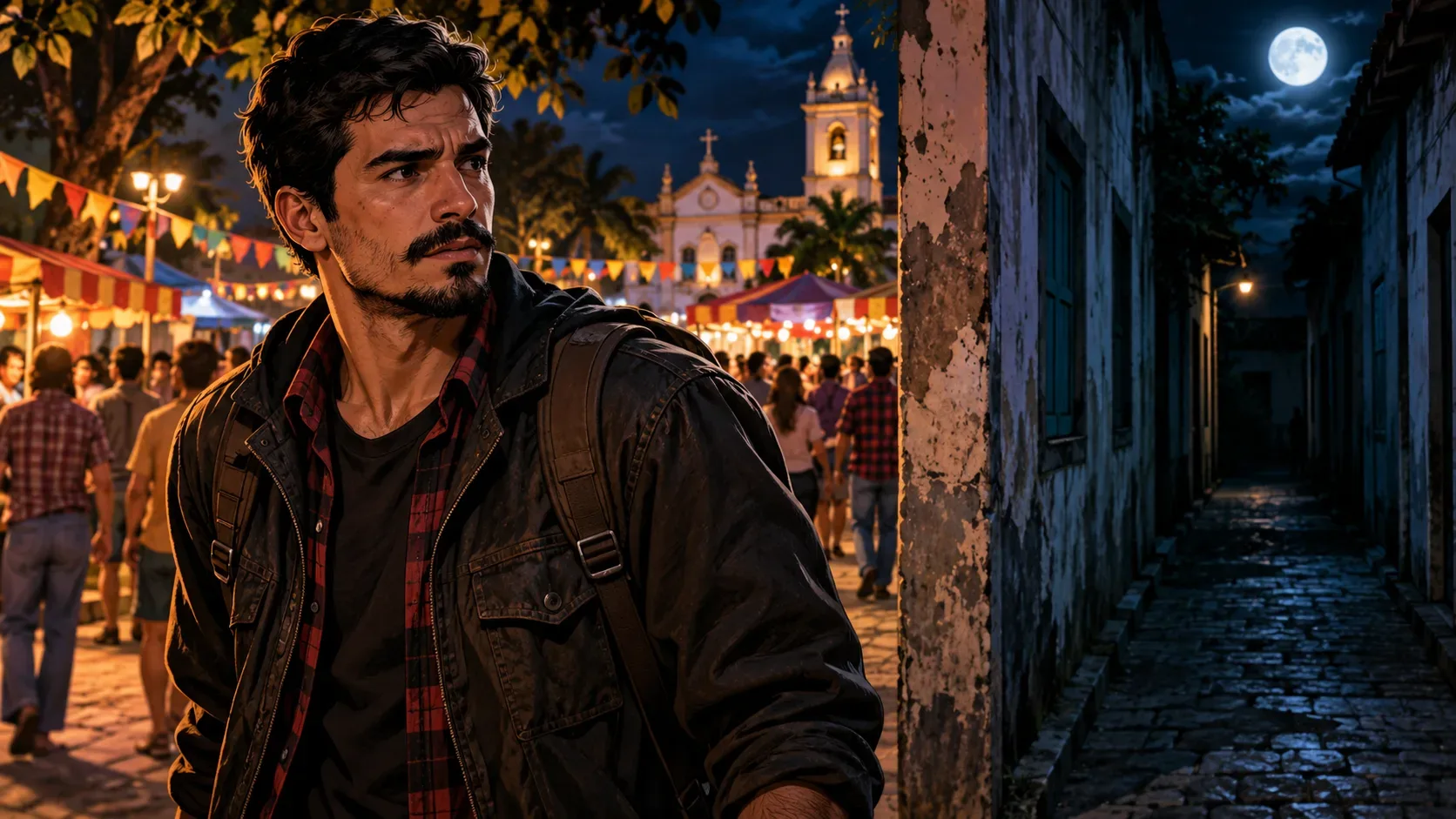
[FIELD] I had left Aracaju to spend four days at a festival in Simão Dias, in the interior of Sergipe. On the final night, walking back alone to my lodging along a side street, I encountered a creature near a walled lot and an old warehouse. It walked upright, with fur, claws and wolf-like features mingled with a disturbingly human face. It was too fast. I was wounded and bitten on my left shoulder.
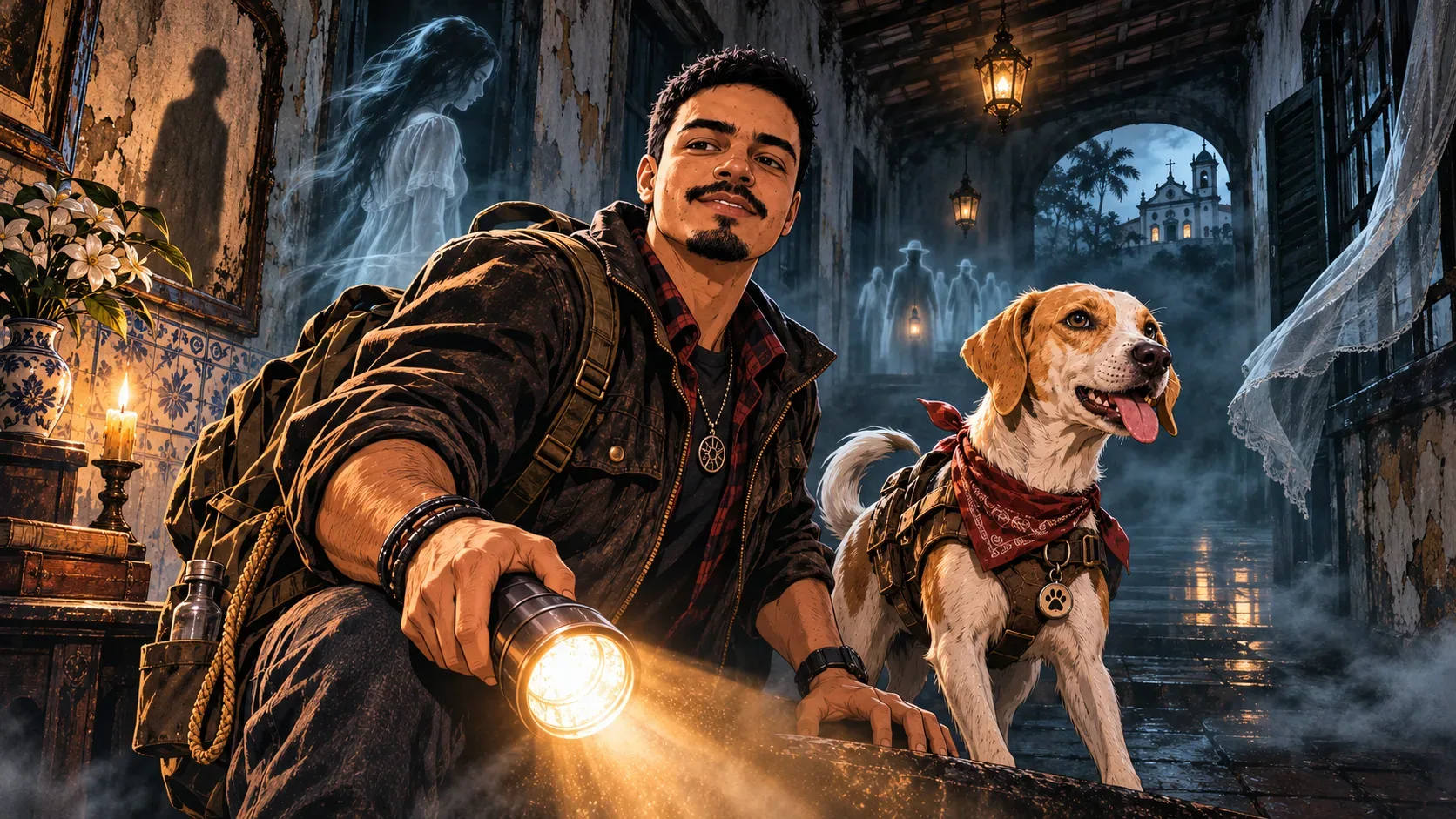
Babizinha arrived, gave me first aid and brought help. The attacker fled when other people approached. She is a nurse, learned to investigate creatures from her grandfather, and later taught me how to survive my own investigations. The bite was followed, some time later, by a transformation of my own. I know the events in my case are connected; I do not know whether every bite transmits the condition or what sets off each change.
There was a full moon. That describes the night, not a law of nature. Aurora did not witness the attack, either: Babizinha gave me the little dog, still a puppy, only months afterward. The werewolf that attacked me still has no name and no known whereabouts.
2. Where the legend comes from
[RECORD] I found no single birthplace for the werewolf. In the fifth century BCE, Herodotus recorded what others said about the Neuri, a people supposedly able to become wolves for a few days each year. He expressed doubt himself. Ovid told of Lycaon's transformation into a wolf as divine punishment. Neither established biting as a universal rule of contagion.
In Petronius's Satyricon, a soldier removes his clothes, becomes a wolf and later appears wounded in the same place where the animal was supposedly struck. It is a literary story, but it offers two recurring clues: clothing and wounds. In Marie de France's Bisclavret, a man retains human understanding while in wolf form, and his clothes matter to his return. That challenges the idea that every transformation erases the person.
Europe also saw trials of people accused of lycanthropy. Thiess's case, in seventeenth-century Livonia, is unusual: he claimed werewolves protected crops. A historical testimony proves that someone made the claim, not that the phenomenon was demonstrated. I record the distinction, because an accusation can destroy a life even when no creature has been found.
3. Portugal, Brazil and other forms
[RECORD] In Portuguese folklore collections, including those of Consiglieri Pedroso, the afflicted person does not always become a wolf: they may become a dog, donkey or goat, follow prescribed routes and bear a fado or fadário, a kind of destined curse. In Brazil, this Iberian material developed regional variations. Some accounts invoke birth order, family curses, nocturnal wandering or bodies resembling dogs, pigs or mixtures of animals. Pereira da Costa recorded traditions from Pernambuco in which barking dogs announce a creature's passage.
In the Río de la Plata region, the Luisón or lobizón appears in accounts involving a seventh son and canine shapes. I do not assume these beings are identical to my attacker. Nor do I confuse the maned wolf, a real wild animal native to South America, with any supernatural description. The word werewolf covers too many accounts for a single sketch to settle them all.
4. Sightings and tracking clues
[RECORD] The written cases include Petronius's wolf-soldier, the rational wolf of Bisclavret and European testimonies about transformation. In France, the attacks attributed to the Beast of Gévaudan between 1764 and 1767 caused documented deaths; they never proved the animal was a transformed human. [FIELD] My only direct encounter documented in this notebook remains Simão Dias. I will not pass off ancient legends as interviews I conducted.
[HYPOTHESIS] A physical creature can leave traces: damaged fences, impressions in mud, blood, hair, displaced objects and noises. But dogs, pigs, people, wild animals and accidents can produce similar evidence. I investigate sequences, not a single footprint. I speak to witnesses separately, compare times, lighting, distance and lunar phases, look for contradictions and examine a location by day before returning at night.
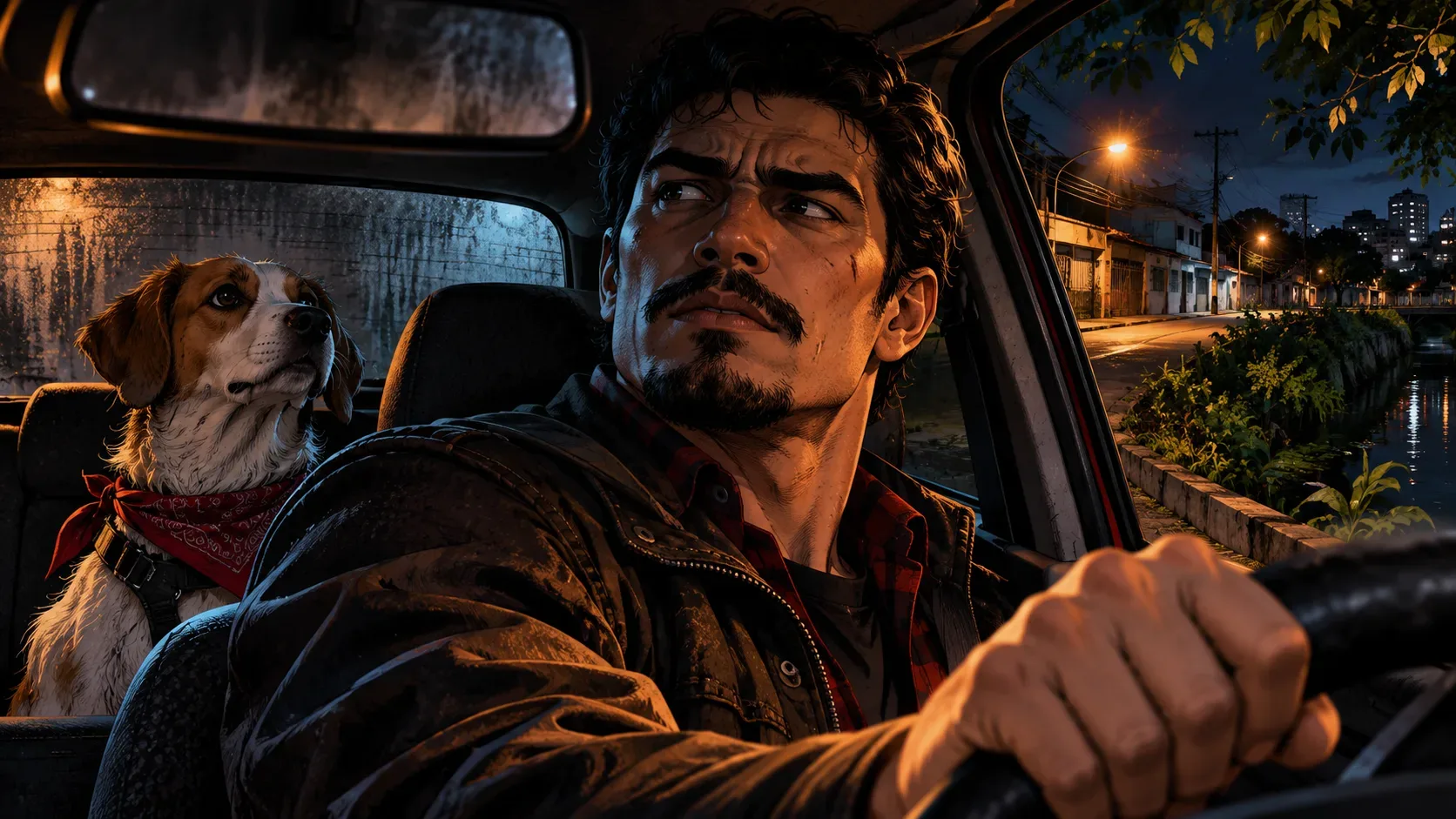
Aurora notices smells and movements I might miss, but she cannot identify werewolves by magic. If she is frightened or retreats, I take her away. She will never be bait. Barking in a town may signal many things; it is not a verdict. I also refuse to turn residents' tired appearance, pallor or unusual behavior into evidence of a curse. A hunter who persecutes people on hearsay may be more dangerous than the story that set him searching.
5. Weaknesses, cures and ways to face one
This is where my notes become most dangerous. I must distinguish three questions: what drives the creature away, what reverses the transformation and what can kill it? Accounts often muddle the answers.
[RECORD] Silver, especially the silver bullet, became famous in modern werewolf stories. Brazilian traditions mention projectiles associated with wax from candles used in religious ceremonies. Other versions say a wound and spilled blood can break the spell; some contradict this and claim the curse may pass to the person who causes the wound. In Bisclavret, recovering the clothes is part of returning to human form. Prayers and blessings appear in some local accounts. Fire, aconite and beheading also occur in adaptations, but I have no evidence that they would work in my case; fire and aconite are dangerous in their own right.
[FIELD] I did not see silver, blessings or a killing blow stop my attacker. I saw only that it fled when people drew near. I cannot say whether this was fear, calculation or something else. No weakness has been confirmed for case SD-01. Hurting someone to test a tradition is not research; it is cruelty. And killing a creature that might regain its awareness would be a mistake that cannot be undone.
My procedure begins before a confrontation: confirm the threat, move residents and animals out of danger, and arrange escape and medical assistance. If the being responds, hesitates or recognizes someone, I try to stop the assault without killing it and understand its condition. If there is no way out and lives face immediate danger, killing it may be necessary, but I will not promise an infallible method I have never tested. Afterward, I record what really happened. Without identification and evidence, I will not write “creature dead” just to close a file.
6. What I still need to learn
[FIELD] The bite was followed by my transformation, but the mechanism remains unknown. I have not established any universal trigger, duration, memory pattern, degree of control or cure. Other accounts attribute the condition to punishment, birth, pacts or enchanted objects. Perhaps the same name hides different natures. I still need to find out who attacked me in Simão Dias, and why Babizinha chose to save me when I had begun carrying the very thing she hunted.
Sources noted in my notebook: Herodotus, Histories, IV.105; Ovid, Metamorphoses, I; Petronius, Satyricon; Marie de France, Bisclavret; Consiglieri Pedroso, Contributions to a Portuguese Folk Mythology; F. A. Pereira da Costa, Folclore pernambucano; historical records concerning Thiess and the Beast of Gévaudan. These sources tell me what was recorded; they do not certify that every creature existed.
"If I must kill a werewolf to prevent a death, I want to know there was no alternative. Until then, I must remember: I was saved when someone could have treated me as nothing but a monster."