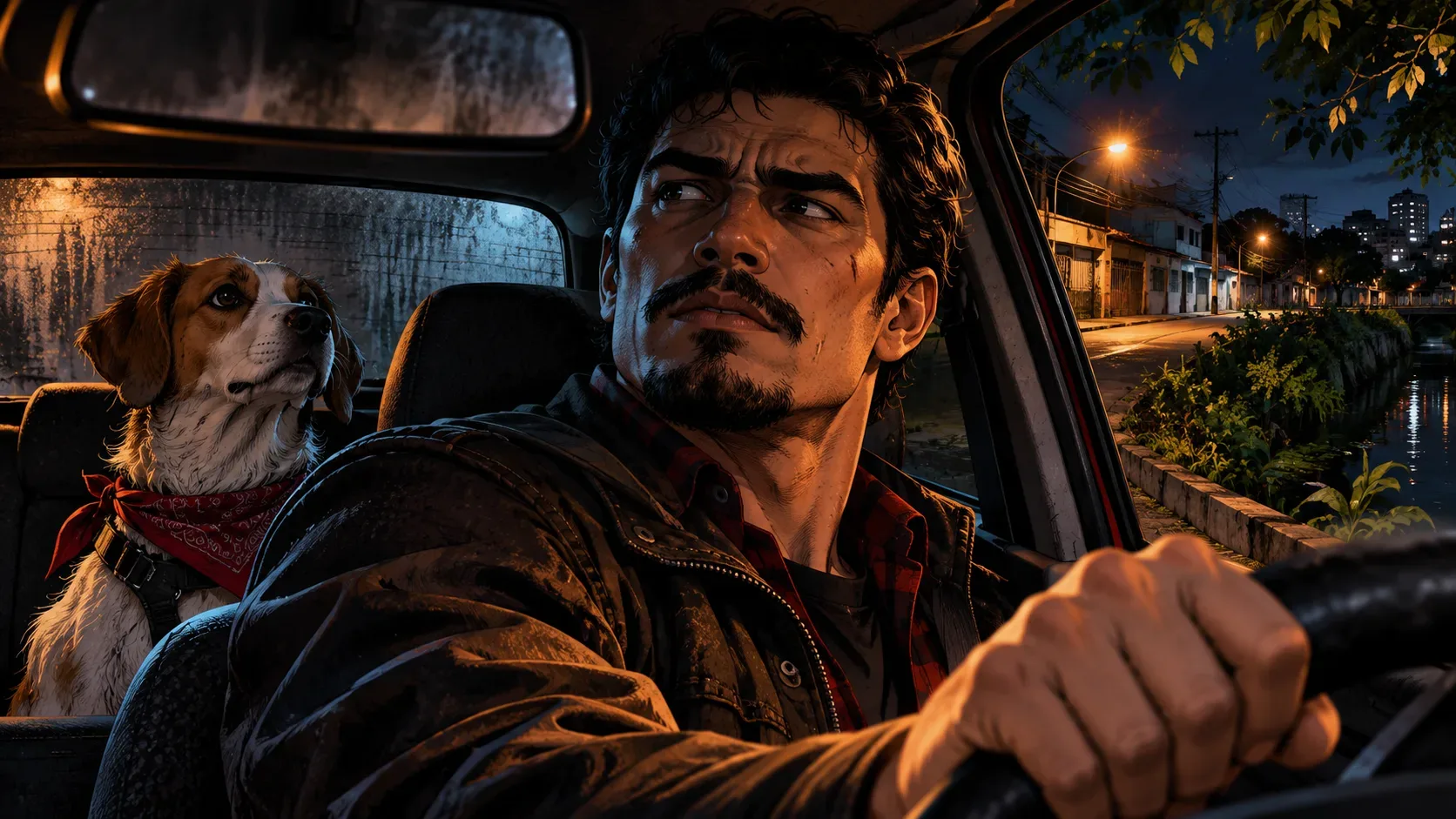
The passenger got into the car without a sound. He named a street, settled into the back seat, and stared out the window. When the driver looked for his face in the rearview mirror, there was nobody in the seat anymore. Yet the empty upholstery still seemed to bear the indentation of a person.
This is the kind of story that travels across cities and generations. The road changes its name, the vehicle changes, the destination changes. What remains is the question behind every ghost story: who, or what, was left behind?
Ghosts occupy a special place among supernatural beings. A werewolf transforms the body; a ghost challenges the very idea that death ends a presence. It does not always appear as a transparent figure. It may look like an ordinary person, repeat a phrase, make a familiar noise, or simply leave someone feeling that they are not alone. And in these accounts, it does not always intend to hurt those who encounter it.
The Dead Who Live On in Stories
In many cultures, haunting stories arise from a disappearance, a violent death, an unfulfilled promise, or the difficulty of accepting a farewell. That does not mean every people explains its dead in the same way. To some, the apparition is a restless soul. To others, it is a visagem, a memory bound to a particular place, or even a warning whose origin cannot be explained.
In Brazil, the names vary as much as the settings. Some say fantasma (ghost), others alma (soul), assombração (haunting), or visagem (apparition). In Amapá, research into popular vocabulary has also recorded names such as visão, vulto, and misura. The terms overlap, but they do not necessarily describe one single kind of supernatural being.
The signs recur in the stories, too: a voice in an empty house, footsteps in a hallway, furniture that seems to move, a smell with no apparent source, a figure seen on the same stretch of road, or a person who vanishes when someone looks away. These are motifs from folklore and testimony, not proof that every strange occurrence is caused by spirits.
Haunting Stories from Brazil
The Soul That Returns to Reveal a Buried Treasure
Stories told about old plantation houses, farms, and mansions feature dead people who cannot rest because they left a secret hidden. One traditional motif is the botija: coins, jewelry, or objects buried somewhere only the deceased knew about. The soul supposedly appears to point out the hiding place or ask someone to settle unfinished business.
The scene changes with the storyteller. Sometimes an old man appears at the foot of the bed. In other versions, someone hears footsteps crossing the floorboards of a locked room. This is not necessarily a vengeful haunting. The fear comes from the dead person's persistence in trying to be heard.
There is another side to these tales: warped doors, uneven floors, wind, and old houses can make astonishing sounds. The power of the story lies precisely in the uncertainty between an everyday explanation and what the witness believes they saw.
The Blonde Woman in the Bathroom
Few Brazilian hauntings circulate as widely among children and teenagers as the Loira do Banheiro, or Blonde Woman in the Bathroom. In popular versions, students summon an apparition in front of a mirror, usually by performing a series of repeated gestures in a school bathroom. The details of the summoning vary from town to town, and the legend has no single documented formula.
More interesting still is the path the story has taken. Whispered during school breaks, it changed when it reached the internet and spread through different parts of the country. In many versions, the blonde woman appears to frighten people; in others, she is given a sad past involving a young woman who died before living the life she wanted. There is no reason to treat any one version as the final explanation for all the others.
Processions, Apparitions, and Requests for Prayer
Other accounts tell of white-clad figures crossing deserted streets, processions that can never be caught up with, and dead people returning to ask for a prayer or restitution. In traditions connected with popular Catholicism, stories tell of souls requesting masses for the departed. The presence is frightening, but its narrative purpose is not always to harm the living.
It is important not to confuse a procession of the dead, a figure of legend, with real religious practices involving prayers for souls. Real people take part in processions, pilgrimages, and devotions. Those observances are not supernatural apparitions and should not be presented as such.
In the haunted Recife of traditional tales, for example, there are stories of former masters who reappear asking for forgiveness or masses. Beyond their scares, these narratives carry unsettling memories of injustice, guilt, and the cities' past.
Ghosts Elsewhere in the World
The Passenger Who Disappears
One of the best-known forms of the vanishing hitchhiker legend tells of someone found on the road at night. A driver offers help; the passenger gets in, gives an address, and disappears before reaching the destination. Later, someone reveals that the person supposedly died years earlier, sometimes on that very bend or along that same road.
Versions change from country to country. In some stories the passenger leaves an object behind; in others she never speaks; in still others the driver sees her only in the rearview mirror. The figure does not necessarily represent a murderous spirit: in many accounts, she merely repeats a journey she could not finish. This folkloric motif is directly connected to the kind of mystery Dant would later investigate in Aracaju.
La Llorona, the Weeping Woman
In Mexico and other parts of Latin America, the legend of La Llorona tells of a woman whose cries carry through the night, often near water. In some versions she is searching for her children; in others she pursues those she meets; other accounts give her different pasts. Her most consistent feature is her weeping; the rest of the story changes according to tradition and storyteller.
Her lament may serve as a warning, a haunting, or the expression of a loss that cannot be repaired. For that reason, she should not be reduced to one biography or presented as a ghost with universal powers and weaknesses.
The Banshee's Warning
In Irish folklore, the banshee is often associated with the announcement of a death through a wail. Her appearance varies: she may be described as young or elderly, wearing different clothes and hairstyles depending on the account. But one distinction matters: the traditional name is linked to the idea of a woman of the fairy world, not simply the ghost of someone who has died.
The banshee shows how the boundaries between warning, spirit, and haunting can differ from what cinema tends to suggest. Not every supernatural figure who weeps is seeking revenge, and not every omen is an attack.
What Do Apparitions Seem to Want?
Storytellers describe ghosts who seek people out, others who guard places, some who repeat an action, and others who react to nothing at all. For fictional investigations, these tales suggest useful questions rather than a definitive classification of species.
An apparition may appear to repeat a memory, always emerging at the same time or where something happened. It may seem to ask for help, insisting on names, objects, and paths. It may warn of a real danger even as its presence causes panic. And it may indeed behave in a threatening way, pursuing someone or leading a victim toward a dangerous place.
The difference cannot be read from appearances. A young woman in white may be as dangerous as a misshapen shadow; a terrifying silhouette might be trying to communicate something. What matters is observing the pattern, listening to the accounts, and considering what happens to the people nearby.
How to Deal with a Possible Haunting
In traditional tales, responses to apparitions vary: some people pray for the dead, seek a spiritual leader from their own tradition, keep their distance, turn to objects believed to offer protection, or try to learn the deceased person's name. These are cultural practices and beliefs, not methods with demonstrated supernatural effectiveness.
In the world of Dant contra o Sobrenatural, none of these alternatives should automatically work on every ghost. A sound investigation begins before any ritual or confrontation.
First, get out of immediate danger. An apparition on the road can disorient a driver. A noise inside an abandoned building can draw someone toward a broken staircase. Water, traffic, exposed wiring, and unstable structures remain dangerous, whatever the source of the fright.
Next, check what can be verified. Dant can interview witnesses separately, compare times, identify smells, examine marks, and look up old news reports. Dreams, rumors, and memories reveal something about the people telling them, but they are not substitutes for evidence. The question is not merely “did you see a ghost?” but “what exactly happened, and what changed afterward?”
Then, identify the pattern. Does the presence appear to a specific person? Does it return to the same place? Does it repeat a sentence? Does it seem to react to objects, someone's approach, or events resembling its death? Repetition may reveal more than the entity's appearance.
Approach folk protections with judgment. Salt, iron, candles, symbols, prayers, and blessings appear in traditions and supernatural fiction, but they do not make up a universal manual. Dant may know these accounts without assuming that a substance can trap or harm a spirit. Religious practices must be treated with respect and never imposed on residents or families.
If there is a sign of communication, do not mistake dialogue for a guarantee of safety. Speaking to an apparition may be possible, but making it listen may also be impossible. Any attempt at contact must consider the danger, the wishes of those involved, and the possibility that the living have misunderstood what is happening.
If the manifestation threatens someone, protecting the living comes first. Moving witnesses away, stopping people from approaching, and seeking practical help may matter more than proving the phenomenon's nature. Retreat is not failure. Attacking a presence without understanding it may increase the danger or simply strike real people and objects.
The principle is simple: investigate before fighting. Not because every ghost is innocent, but because fear alone tells us nothing about anyone's intentions.
A Case on the Streets of Aracaju
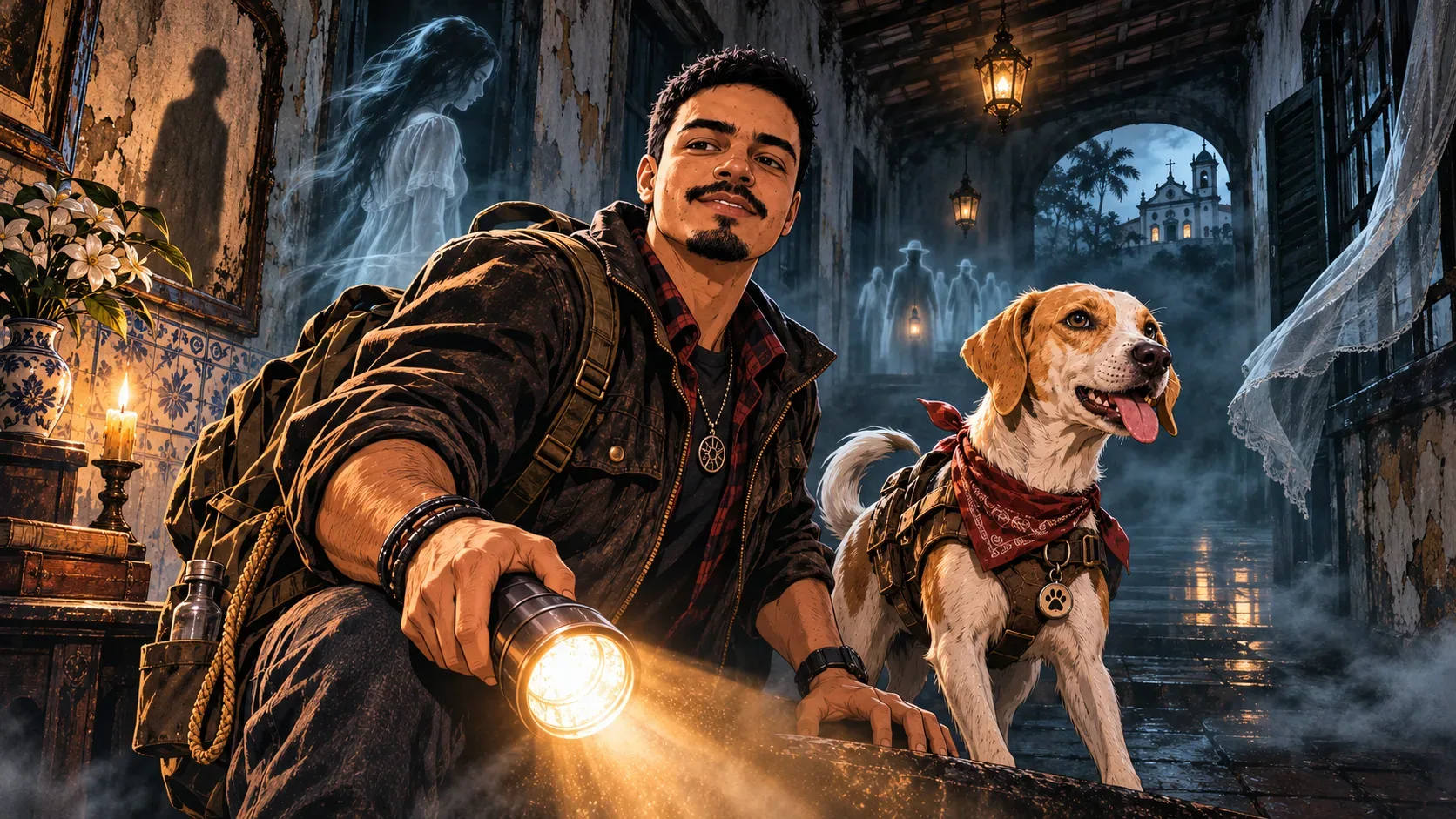
Dant faced this very dilemma in Conjunto Augusto Franco, Aracaju, in A Última Carona (The Last Ride), the series' second episode. Reports of strange deaths prompted him to investigate stories of a blonde woman who appeared to drivers. His initial theory was that a dangerous haunting might be connected to the accidents. What he found was more complicated.
From this point on, there are spoilers for Episode 02.
In the fictional story, the apparition was linked to Marta Almeida, a young woman who died in a flash flood while trying to save her brother, Davi. The ghost seemed trapped in the urgency of that moment. Repeated references to water, a boy, and a plea for help helped Dant realize that the woman might not know Davi had survived.
Aurora played her part as a dog, not an infallible spirit detector: she sniffed out clues associated with carnations and, at the decisive moment, her barking stopped Dant from stepping into a dangerous area beside the canal. Dant brought the surviving brother and the apparition together. Davi showed Marta a photograph and spoke to her; she seemed to recognize him and vanished.
That did not prove that Marta had reached the afterlife. Nor did it establish that she had directly caused the two deaths under investigation. The case ended with a measure of relief, not with every question answered. Dant still had to deal with the physical danger of the passage near the canal, regardless of the supernatural phenomenon.
Marta is a character invented for the episode, not the historically verified identity of an Aracaju legend. Her story illustrates just one dramatic possibility among many: a haunting that did not need to be destroyed in order to stop inspiring fear.
The Last Question
Ghost stories often begin with the wrong question: “How do we make this disappear?” Before that, it is worth asking why someone believes the presence is there, what marks it has left on the living, and what danger actually exists.
Some stories will end in a farewell. Others, in flight. Still others will remain unexplained. In Augusto Franco, Dant learned that not every unknown creature is an enemy, and that no single method works for every case.
The most unsettling question, however, remains unanswered: when a voice calls from the other side of death, how can anyone know whether it is asking for help, warning of danger, or inviting someone to follow it?